
How Can I Learn Economics on My Own Like a College Student?
Master university-level economic principles by turning AI into your personal, on-demand professor.
To master economics without a formal degree, use ChatGPT or Claude as your primary tutor. By instructing these models to act as a university professor, you can simulate a structured curriculum, generate practice exam questions, and receive instant, rubric-aligned feedback on your analysis of complex economic models.
Learn economics independently by using AI to simulate a structured college curriculum. This guide identifies the best tools for conceptual mastery, data analysis, and academic research to help you learn faster and more effectively.
Why AI is the Ultimate Economics Tutor
The most effective way to learn economics is to stop treating AI as a search engine and start treating it as a professor. Traditional self-study often fails because it lacks the feedback loops found in a classroom, but modern large language models can now simulate these interactions by providing step-by-step guidance on complex theories like supply and demand, elasticity, or game theory. By using a structured prompt, you can force the AI to act as a mentor rather than a simple answer machine.
To get started, provide your AI with a clear persona: Tell it to act as an economics professor who specializes in undergraduate curriculum design. Ask it to break down a specific topic, such as market failure, and then request that it quiz you on the material before moving to the next lesson. This active learning approach ensures you are not just reading definitions, but actually applying economic logic to real-world scenarios.
When you encounter a difficult concept, do not just ask for a summary. Instead, ask the AI to explain the concept using a specific model, such as the AD-AS framework, and then ask it to identify the limitations of that model. This mimics the critical thinking required in university-level courses and prevents the superficial understanding that often comes from passive reading.
How to Build Your Own Economics Curriculum
You can replicate a college-level experience by asking your AI to generate a syllabus based on standard university textbooks. Start by asking the tool to create a 12-week study plan that covers microeconomics and macroeconomics, including weekly learning objectives, key definitions, and suggested practice exercises. This provides the structure necessary to avoid the overwhelm of trying to learn everything at once.
Once you have your syllabus, use tools like NotebookLM to upload your own reading materials, such as PDFs of economic surveys or academic papers. The AI can then answer questions based specifically on those documents, ensuring that your learning remains grounded in credible, peer-reviewed sources rather than generic internet data. This is a powerful way to synthesize dense information into manageable insights.
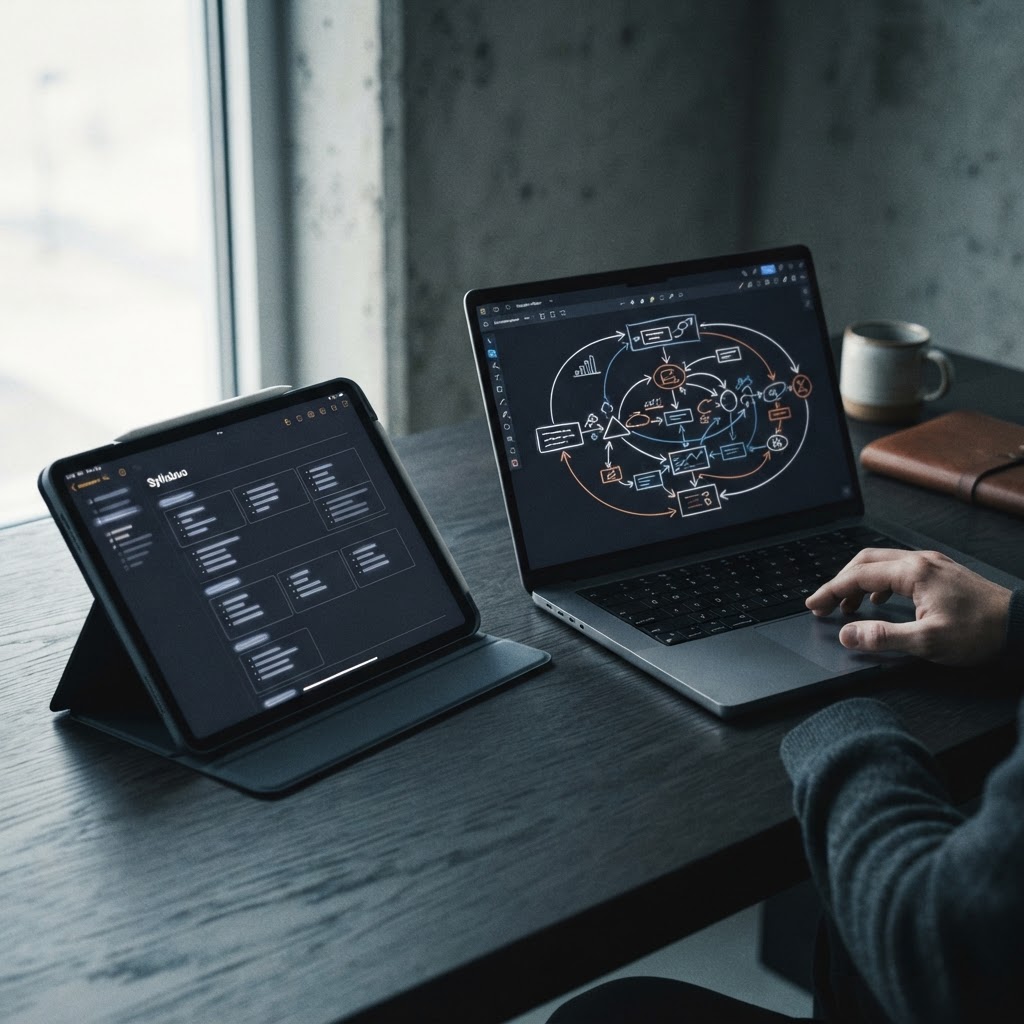
For visual learners, use tools like Napkin AI to convert your written notes into diagrams. Economics is a highly visual discipline, and being able to generate a clear flowchart for concepts like the circular flow of income or monetary policy transmission is essential for deep comprehension. By combining text-based tutoring with visual aids, you create a multi-sensory learning environment that rivals a physical classroom.
The Importance of Critical Thinking and Verification
While AI is an incredible tool for learning, it is not a substitute for your own critical thinking. Economics is a discipline of interpretation and policy analysis, and AI models can sometimes hallucinate or provide overly simplistic answers. Always treat the AI as a starting point for your research, not the final authority on economic truth. You must verify its claims against reliable literature and academic sources.
To ensure accuracy, use Perplexity AI to cross-reference the explanations provided by your primary tutor. Perplexity is designed to provide citations, which allows you to trace the information back to its source. If the AI gives you a definition of price elasticity, check it against a standard textbook or a reputable economic journal to ensure the nuance is correct. This habit of verification is exactly what separates a casual learner from a serious student.
Finally, remember that the goal is to learn how to think like an economist, not just to memorize facts. Use the AI to challenge your own biases by asking it to play devil's advocate. If you are studying a specific policy, ask the AI to provide arguments for both sides of the debate. This practice of evaluating multiple perspectives is the hallmark of a university education and will serve you far better than simply accepting the first answer the AI provides.

AI Economics Learning Toolkit
- ChatGPT: Best for conceptual explanations and essay drafting
- Claude: Best for logical reasoning and complex coding tasks
- NotebookLM: Best for synthesizing your own PDFs and lecture notes
- Perplexity AI: Best for finding credible, cited academic research
- Napkin AI: Best for visualizing economic models and flowcharts
Included with your bundle
AI Consultant Course
The course most members join for. It turns the AI fluency you build in the foundations into a consulting practice — the offer, the pitch, the pricing, and the delivery system.
- Package what you learn into a paid AI offer
- Price it, position it, and land the first client
- Deliver client work with AI in a fraction of the hours