The AI Video Generation Revolution: From Text to Film in Minutes
How 2026’s generative models are dismantling traditional production barriers and redefining the creative workflow.
The AI video landscape has matured into a powerful suite of tools capable of producing cinematic, high-fidelity content from simple text prompts. This article explores the leading platforms, practical marketing applications, and the strategic shift from high-cost production to rapid, AI-driven creative iteration.
The Great Leap: From Blurry Motion to Cinematic Reality
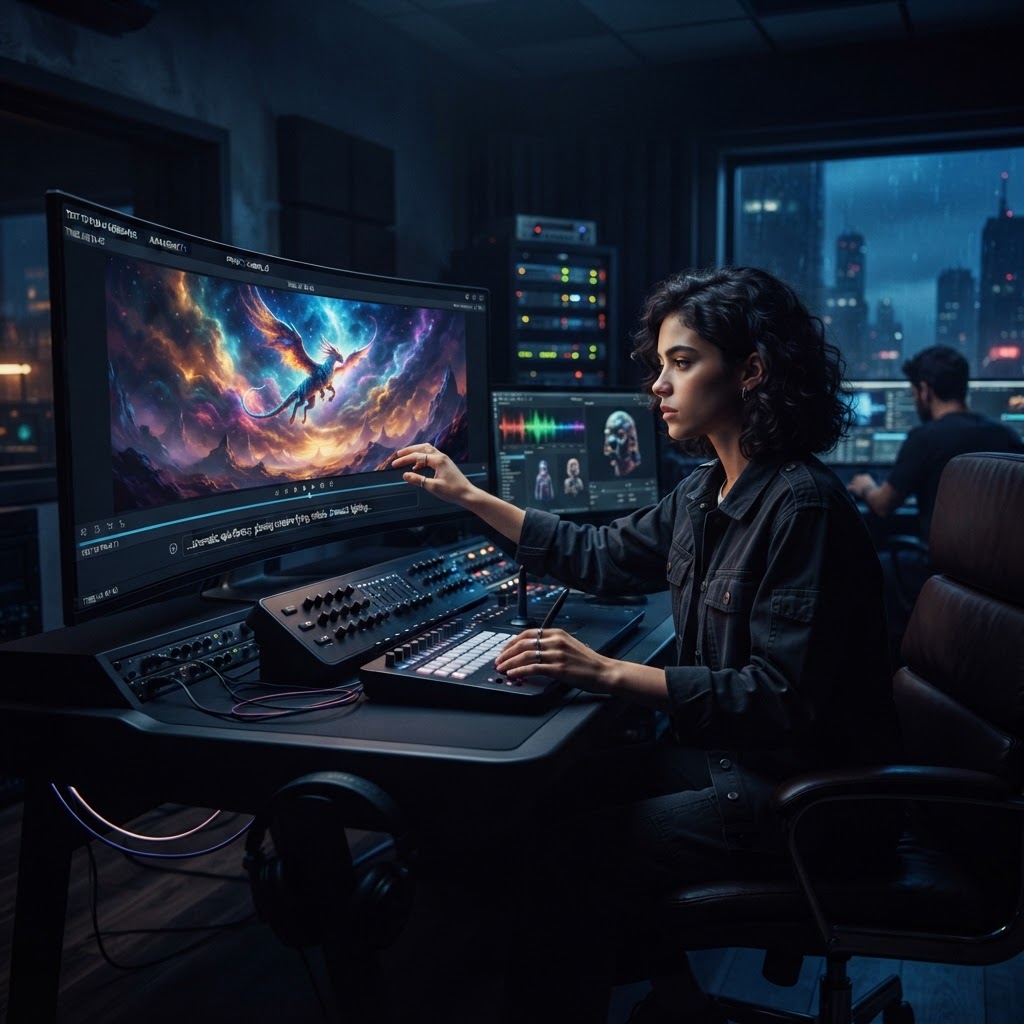
Three years ago, the term 'AI video' conjured images of melting faces and incoherent, four-second loops. Today, the narrative has shifted entirely. In 2026, we are witnessing a technological maturation where models like Google Veo 3.1 and Runway Gen-4.5 can synthesize high-fidelity, 4K-ready sequences that maintain temporal consistency and physical logic. The transition from experimental novelty to professional-grade utility has been rapid, driven by massive advancements in diffusion models that now understand the temporal dimension of film.
This revolution is not merely about replacing cameras; it is about removing the friction between a concept and its visual realization. Where traditional production requires weeks of scheduling, location scouting, and post-production, modern AI tools allow creators to iterate on visual ideas in real-time. The barrier to entry has collapsed, allowing independent creators and enterprise marketing teams alike to produce content that was previously reserved for high-budget studios.
As we navigate the second half of 2026, the market has bifurcated into specialized tools. While some platforms focus on hyper-realistic cinematic output, others prioritize speed, lip-syncing for corporate avatars, or social-media-ready effects. Understanding this landscape is no longer optional for creative professionals; it is a prerequisite for maintaining a competitive edge in an increasingly visual digital economy.
The Titans of 2026: Who Leads the Pack?
The current market is defined by a handful of dominant players, each carving out a specific niche. Google’s Veo 3.1 has emerged as the premier all-rounder, offering exceptional consistency and quality that makes it the current gold standard for premium ad creative. Its integration into broader Google ecosystems has made it highly accessible for teams already embedded in the Google workspace.
Runway Gen-4.5 remains the favorite for creators who demand granular control. Its ability to handle image-to-video workflows with precision makes it indispensable for directors and editors who need to maintain specific visual styles across multiple shots. Meanwhile, Kling AI 3.0 has solidified its reputation as the best option for turning static imagery into convincing, high-motion sequences, often outperforming competitors in complex character movement.
For those focused on social media and rapid-fire content, Pika 2.5 continues to lead in speed and effect-heavy workflows. Its specialized 'Pikaformance' features for lip-syncing and character animation make it a staple for creators who need to turn around daily content without sacrificing engagement. The key takeaway for 2026 is that no single tool is a panacea; the most effective production teams are those that maintain a multi-platform stack, leveraging the specific strengths of each model.
How Diffusion Models Turn Prompts into Film
At the heart of this revolution are video diffusion models. Unlike traditional CGI, which relies on manual 3D modeling and rendering, these models start with a field of random noise and iteratively refine it into a coherent visual sequence. The breakthrough in 2026 lies in the model's ability to process the 'temporal dimension'—ensuring that a character’s movement in frame one remains consistent with their position in frame sixty.
These models are trained on vast datasets of video, allowing them to learn the physics of light, motion, and human anatomy. When you input a prompt like 'a drone shot pulling back from a neon-lit Tokyo street,' the model isn't just retrieving a clip; it is synthesizing a unique visual experience based on its learned understanding of cinematography, lighting, and spatial depth. This is why the quality of the prompt is so critical.
However, these models still have limitations. They can struggle with complex physics, such as the interaction between two objects or the persistence of small details during long, continuous shots. Understanding these constraints is vital for professional users. The most successful creators treat AI as a collaborator, using it to generate the 'heavy lifting' of a scene while reserving manual editing for the final polish and continuity checks.
Marketing and Advertising: The New Efficiency Frontier
Marketing teams are the primary beneficiaries of this shift. The ability to generate localized content for global markets without the need for multiple film crews is a game-changer. Brands can now produce high-quality product demos, social media ads, and training videos at a fraction of the traditional cost. Data shows that AI-generated product videos can increase add-to-cart rates by 27%, proving that the efficiency gains are matched by tangible business outcomes.
For performance marketers, tools like Creatify have become essential. These platforms specialize in turning product URLs into optimized ad variations for platforms like Meta and TikTok, complete with built-in A/B testing. This allows teams to test dozens of creative variations in the time it previously took to produce one, significantly lowering the cost of customer acquisition.
Furthermore, the use of AI avatars—pioneered by platforms like Synthesia—has transformed corporate communications. Companies are now using these tools to scale internal training and global messaging, ensuring that every employee receives consistent, high-quality information in their native language. The focus has shifted from 'how do we film this?' to 'how do we best communicate this message?'
The Ethics of Provenance and Trust
As AI-generated video becomes indistinguishable from reality, the issue of trust becomes paramount. In 2026, the most successful brands are those that prioritize transparency. If a presenter is an AI avatar, the best practice is to disclose it. If a product demo is generated, it should be grounded in real data and actual product capabilities. This is not just an ethical choice; it is a strategic one.
Audiences are becoming increasingly sophisticated at detecting synthetic content. Brands that attempt to manufacture credibility they haven't earned will find themselves facing a backlash. The goal of AI in marketing should be to remove production friction, not to deceive the viewer. Provenance is becoming a major trust signal, and brands that are open about their use of AI look confident and forward-thinking rather than deceptive.
We are also seeing the rise of 'proof-based' content. The most effective AI videos are those that combine the efficiency of generative tools with the substance of real-world data. By using AI to visualize real outcomes, customers, and numbers, brands can create content that is both highly engaging and fundamentally honest. This is the new standard for digital marketing.
Building a 2026 Production Workflow
For creative professionals, the challenge is no longer about learning how to use a single tool, but how to integrate multiple tools into a cohesive workflow. A typical professional setup in 2026 might involve using Sora or Veo for initial concept visualization and B-roll generation, Runway for precise image-to-video control, and Pika for quick social media edits. This multi-platform approach allows for maximum flexibility.
Budgeting for these tools has also become more predictable. While costs fluctuate as providers adjust their credit models, most professional teams find that a monthly spend of $200 to $300 covers a robust suite of subscriptions. This is a negligible cost compared to the thousands of dollars saved on traditional production, location rentals, and post-production labor.
When building your workflow, start by benchmarking. Run the same prompt across two or three models to see which one handles your specific style best. Don't be afraid to swap models as the technology evolves; the AI video market is moving too fast to be loyal to a single vendor. The goal is to build a 'model-agnostic' workflow where you can swap the underlying engine without disrupting your creative output.
Looking Ahead: The Future of AI Video in 2027 and Beyond
As we look toward 2027, the trajectory of AI video is clear: we are moving toward full-length, coherent narrative generation. While current models excel at short clips and specific scenes, the next frontier is the ability to maintain character, style, and plot consistency over 10, 20, or even 60 minutes of film. We are already seeing early signs of this with models that can generate multiple shots within a single sequence.
We also expect to see deeper integration with interactive media. Imagine a video ad that changes its content in real-time based on the viewer's demographic or previous interactions. This level of personalization will redefine the relationship between brands and consumers, turning passive viewing into an active, tailored experience. The technology is no longer just about 'making video'; it is about 'making experiences.'
For those who have been waiting on the sidelines, the time for observation has passed. The brands and creators who are learning these tools today are building a library of assets and a depth of expertise that will be impossible to replicate later. The AI video revolution is not coming; it is here, and it is fundamentally changing the way we tell stories.