
Use Fliki AI to solve your accessibility bottleneck. By generating your narration, captions, and visual structure in a single pass, you eliminate the need for secondary transcription services and manual timing. It allows you to maintain professional, inclusive video standards without the standard hours of post-production labor.
The silent cost of your current workflow
You are sitting at your desk at 9 PM on a Tuesday, staring at a timeline in a video editor that has frozen for the third time tonight. You have already spent four hours recording a training module, only to realize your voice sounded tired midway through. Now, you have to decide whether to live with the mistakes or stay up until midnight to fix them. Worse, you know that even if you finish the edit, you still have to export the file, upload it to a separate platform to generate captions, and then manually check the time stamps because the AI botched the technical jargon in your industry.
This is not a production issue. It is a fundamental bottleneck in how you approach content. You are treating the narration, the visual, and the transcript as three separate jobs, when in reality, they are a single obligation to your audience. The consequence isn't just a missed bedtime; it is the fact that your content is inaccessible to the deaf and hard-of-hearing community, and your search engine optimization is suffering because you cannot afford the time to transcribe every clip you produce.
This page is not about software reviews or feature lists. It is about a structural shift in how you produce professional media. I am going to show you how to move from a multi-stage, high-labor recording process to a single-pass workflow that generates your narration, your visuals, and your accessibility assets simultaneously. We are going to look at why your current setup is bleeding your time and how to plug the leak.
Criteria for Accessible Content Tools
- Simultaneous generation of audio and caption text files.
- Correction of text errors without re-rendering full video files.
- Support for multiple languages with high-fidelity native pacing.
- Compatibility with existing web-ready video formats for SEO.
- Minimal manual effort required for syncing captions to audio.


Stop recording, start shipping.
Reclaim your schedule and turn your text into professional assets in minutes.
See it in actionStop trading your evening for an accessible video.
Your content deserves to be heard and understood by everyone, without the grind of manual recording and endless captioning. Take back your time today.
- Ship professional videos in under 30 minutes
- Ensure full accessibility with built-in captions
- Update your content in seconds, not hours
The hidden expense of ignoring accessibility
Ignoring accessibility in your video pipeline is costing you more than just reputation; it is costing you tangible growth and efficiency. When you skip captioning because it adds two hours to your turn-around time, you are essentially burying your content where search algorithms cannot crawl it and where mobile viewers in public spaces simply scroll past it. If you are paying for video hosting, you are paying for a shelf that your audience cannot actually use.
Calculate the math for your current output. If you produce four videos a month and each requires a manual hour for captioning or a fifty-dollar fee for a human transcriber, you are burning six hundred dollars and twelve hours of focus every single year on a task that should have been handled at the source. This is not just a budget line item. This is time you could spend on strategy, lead generation, or actual high-value creative work.
The real price of waiting is the compounding loss of reach. Every video you ship without a clean, accurate transcript is a missed search result. Over twelve months, those missed signals add up to thousands of potential views that never occurred. When you stop viewing accessibility as an afterthought, you stop viewing it as a chore and start viewing it as a prerequisite for professional content delivery.
Why the standard recording model fails
The standard recording model fails because it separates your writing from your production. When you record a voiceover in a booth, you are creating a static, unchangeable object that binds you to that specific performance for the rest of its shelf life. If you notice a factual error on page three of your script, you cannot just fix the error. You have to re-record, re-edit, and re-export the entire piece. That is why your training audio goes stale; you are too exhausted by the process to maintain the quality.
Professional workflows are collapsing under this weight because the technology used by amateurs and pros alike forces linear progress. You write, then you record, then you edit, then you caption. If anything fails at the final step, you have to go back to the beginning. This is a design flaw. It treats speech as a physical performance rather than digital data that can be managed, corrected, and updated as easily as a text document.
Your disdain for your own voice, or the frustration of hiring a voice actor for minor script tweaks, is a symptom of this rigid process. When the audio is a recording, it is a fossil. When the audio is treated as a piece of data within a production environment, it is a living asset. You are likely trying to work harder to overcome these limitations, but no amount of extra caffeine or better microphones will fix a process that requires you to repeat work every time you change a single word.
The numbers behind the problem
12 hrs
Average manual editing time per month
$750
Annual cost of third-party transcription
45 min
Time required for a full video project
80+
Languages available for instant narration


Stop recording, start shipping.
Reclaim your schedule and turn your text into professional assets in minutes.
Watch the 4-minute demoSetting the bar for your production stack
To fix your workflow, you must demand a tool that treats accessibility as a native output rather than an export option. The criteria for your next production stack are straightforward: the tool must generate the audio file, the caption data, and the visual structure in a single pass. If a software solution requires you to export your audio to a third party to get a transcript, you have not actually solved the bottleneck; you have only moved it to a different tab.
Look for systems that allow for modular editing. A professional-grade tool must allow you to change one word, one sentence, or one slide without requiring the entire project to be re-rendered. This is the difference between a studio session that eats your entire afternoon and a ten-minute update that happens before your morning coffee. Your time is worth too much to be spent managing render bars and file conversions.
Finally, evaluate the tool based on its linguistic flexibility. You may only be shipping in English today, but the ability to generate a global version of your course or product guide at the click of a button is a massive competitive advantage. If your platform traps you in one language or one voice, you are building a cage for your content rather than a bridge to a wider audience. Every minute spent toggling between different apps is a minute you aren't creating.
What the professional fix looks like
A high-performance production workflow replaces the microphone with a script-first engine. In this environment, you paste your text, select a voice that matches your brand authority, and immediately see the visuals and the captions populate in real-time. This is the shift from a recording process to an editing process. You are no longer managing performances; you are managing information.
When you adopt this, the time investment for a video drops from an entire evening to a focused thirty-minute session. You write the script, verify the timing, and hit generate. Because the captions are baked into the data layer of the project, they are ready the moment the video finishes rendering. There is no searching for captioning software, no uploading to external sites, and no waiting for someone else to process your request.
This is how you sustain a weekly content cadence without burning out. By removing the physical barrier of recording, you remove the psychological barrier of hesitation. You stop editing for voice quality and start editing for impact. When you see how quickly you can move from a rough idea to a polished, captioned, and accessible video, you will wonder why you ever spent so much time locked in a cupboard with a microphone.
Replace studio hours with editorial focus
Stop manual recording and let the engine handle your narration and visual flow.
- Generate voiceovers from text in seconds
- Automated captioning for total accessibility
- Change one word, not the whole project
What you actually get, feature by feature
Intelligent Text-to-Video Engine
Converts plain text into a complete visual production, removing the need for traditional recording hardware.
Multi-Language Voice Synthesis
Allows you to expand your reach to international markets with consistent voice quality in 80+ languages.
Inline Caption Generation
Produces accurate, time-synced captions during the initial render process for total accessibility compliance.
Modular Script Editing
Enables you to update a single line or slide without regenerating the entire project file.
Visual Asset Integration
Provides access to a vast library of visuals that turn static narration into engaging media.
Real-Time Preview Editing
Lets you see and hear your final production while making changes, ensuring accuracy before export.
Proof of the Shift: Your Workflow One Week Later
You will trade your five-hour Saturday editing sessions for a forty-minute block on Monday morning. By shifting your process to Fliki AI, you stop treating every video like a film production and start treating it like a document update. Your draft script becomes a finished video with captions and voiceover while you finish your first coffee. You no longer need to wait for a quiet house or a professional studio to record narration.
Consider the math. Last week, you spent six hours fighting with audio levels and syncing captions on a three-minute explainer. Next week, you paste that same script into Fliki, select a professional voice, and hit export. Because you can tweak a single line of text and regenerate only that segment, you spend three minutes fixing a late-stage script change instead of rerecording the entire audio track from scratch. This is the difference between a project that gets delayed by a week and one that ships by lunch.
Your output quality remains consistent because it relies on standardized voice profiles rather than your mood, energy levels, or the ambient noise in your office. Your team gets the training modules they need, and your audience gets the accessible, captioned content they expect, without you ever having to buy a microphone or learn the nuances of sound engineering. You are simply choosing to prioritize shipping over manual labor.
Addressing Your Real Hesitations
You are likely worried about three things: sounding robotic, the cost of a subscription, and the time it takes to learn a new tool. The reality is that modern voice synthesis has moved past the unnatural inflections of older technology, and the subscription cost is cheaper than the hourly rate you would pay a freelance editor to perform the same task once. You do not need to be a video producer to make this work; if you can edit a document, you can produce a professional video.
Regarding the price, look at your current cost of inaction. If your time is worth one hundred dollars an hour, then those six hours you spend on a single video project cost you six hundred dollars in lost opportunity. A subscription to Fliki AI typically pays for itself in the first hour of a single month by returning those lost hours to your calendar. The learning curve is almost flat because the interface is built around text, not a complex timeline.
You might fear that AI content feels impersonal, but the audience does not care how the audio was created; they care that it is clear, captioned, and concise. They care that they can consume your content on mute during a commute because you finally prioritized accessibility. If the tool saves you five hours, that is five hours you can spend on strategy, customer service, or actual rest, rather than technical busywork.


Stop recording, start shipping.
Reclaim your schedule and turn your text into professional assets in minutes.
Start your first projectThe Cost of Doing Nothing for Six More Months
If you continue to ignore your accessibility gap for another six months, you will lose approximately one hundred and thirty hours to manual video editing and synchronization. That is over three full work weeks of your life spent on tasks that add no unique value to your brand or your expertise. You will continue to bury your best ideas because the effort required to produce them feels too high, meaning your market presence remains stagnant while your competitors automate their distribution.
Staying with your current manual workflow is a active choice to remain inefficient. Every time you push a video project to the bottom of your to-do list because you dread the recording and editing process, you miss an opportunity to capture leads, educate clients, or solidify your authority. This inaction creates a cumulative deficit in your content library that will take years to recover. You are not just missing out on individual videos; you are missing the compounding effect of regular, accessible content reaching your target audience.
The friction of recording and editing is the single greatest reason professionals stop creating content altogether. When you accept this friction as a permanent part of your work life, you decide that your time is worth less than the price of a more efficient tool. You are essentially paying for your own burnout with your own time.
Making the Decision to Ship
Deciding to use Fliki AI is the moment you stop letting technical constraints dictate your content strategy. You have a choice: you can continue to spend your evenings in a dark room trying to get a clean take, or you can leverage a tool that treats your words as the primary asset. The decision to buy is simply the decision to stop being the bottleneck in your own business growth.
Take the first step by running one of your existing, unrecorded scripts through the platform. You will immediately see the time savings as the narration and visual structure populate in front of you. Once you see your own content appearing in a finished, accessible format without your direct intervention, you will realize that the barrier to entry was never the quality of your ideas, but the complexity of your execution. You are not replacing yourself; you are replacing the repetitive, low-value labor that holds you back.
Choose to reclaim your time today. Click the button to start, upload your script, and watch as your workflow shifts from manual labor to editorial management. The work you do in the next ten minutes determines whether you spend the rest of the month scrambling to edit or focusing on the work that actually generates revenue.
What this actually looks like
Straight talk: the pros and the cons
What you get
- Generates captions and transcripts alongside narration.
- Edit scripts to update video without re-recording.
- Lifelike voices that avoid robotic inflection.
- Support for 80 plus languages in a single dashboard.
- Native visual assets reduce reliance on stock footage sites.
Worth knowing
- Requires manual check for complex technical terminology.
- Limited customization of complex video scene transitions.
- Requires internet connectivity for all rendering operations.

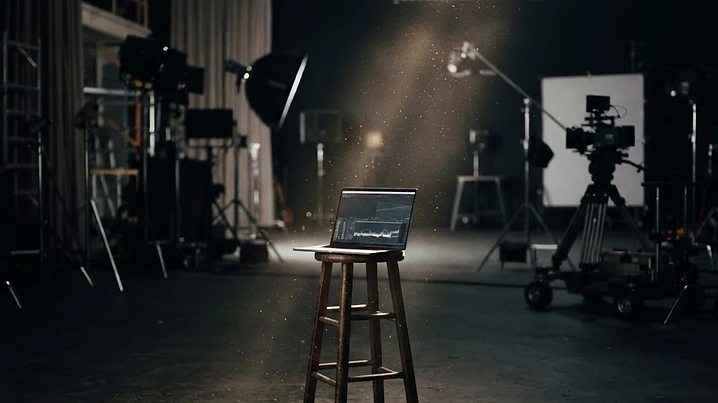
Ship more by doing less
Scale your output without hiring a production team or spending hours in post-production.
- Create weekly clips from existing text
- Consistent voice quality across all files
- Over 80 languages for global reach
How it works, step by step
- 1
Step 1
Import Your Script
Paste your existing text content directly into the editor to create the base structure.
- 2
Step 2
Select Brand Voice
Choose from hundreds of lifelike voices that fit the tone of your professional brand.
- 3
Step 3
Sync Visuals and Audio
Assign visual assets or stock media to your script blocks to match your narration.
- 4
Step 4
Verify Captions
Review the automatically generated captions that align perfectly with your chosen voice.
- 5
Step 5
Export and Ship
Render your high-quality, accessible video file with captions embedded for immediate use.
Your roadmap: what the first 30 days look like
- 1
Day 1
Initial Setup
Upload your existing script and generate your first professional video with captions in under ten minutes.
- 2
Week 1
Workflow Integration
Build a library of content by converting your old blog posts into narrated, visual explainers.
- 3
Week 2
Standardized Output
Establish a consistent brand voice across all your team's training and product documentation.
- 4
Month 1
Full Adoption
Eliminate manual recording entirely and move your entire video production process into the dashboard.
- 5
Month 3
Compound Results
Observe a major increase in content reach as your library expands with accessible, high-quality videos.
Stop Waiting for a Perfect Recording Session
You have spent enough time being the person who has the knowledge but lacks the means to distribute it efficiently. You have analyzed the math of your own workflow and you know exactly where your hours are leaking. Holding onto an obsolete manual recording process is not a sign of quality control; it is a signal that you are misallocating your most limited resource. Your expertise is in your perspective, not in your ability to operate audio mixing software or sync captions frame by frame. When you remove the production friction, your output will increase because you will finally be able to ship at the speed of your ideas. The next six months could be your most productive period yet, or they could be another stretch of half-finished projects and missed opportunities. You have the tool, you have the script, and you know the cost of the status quo. In the next ten minutes, sign up, paste your current text, and generate your first video. Watch how the captions appear automatically and how the narration matches the pace of your writing. Once you see the final result, you will not go back to the microphone or the editing suite. You will simply choose to be the person who writes, edits, and ships. The choice is yours to make before you close this tab and return to the cycle of work that you are already tired of. Start the transition today, regain your time, and start treating your content as a competitive advantage rather than a chore.
Stop recording, start shipping.
Reclaim your schedule and turn your text into professional assets in minutes.
Get Fliki AI nowAffiliate disclosure: the links on this page are affiliate links. If you buy through them we may earn a commission at no extra cost to you. It never changes what we recommend.