
Fliki AI is the most effective tool for creators who need to publish video content but hate the sound of their own voice. It lets you paste a script and instantly generate human-like narration in hundreds of voices, allowing you to edit text rather than re-recording audio files entirely.
The hidden tax on your creative time
You spend your Tuesday evening sitting in a quiet closet, microphone in hand, reading the same sentence for the fifth time. You keep tripping over a specific word, your voice sounds thinner than you imagined, and the ambient hum of your room is ruining the take. You are not just making a video; you are fighting a losing battle against your own self-consciousness. By the time you finish, you are exhausted, the file is unpolished, and the idea of doing this again next week makes you want to quit content creation entirely.
This page is not about how to be a better voice actor. It is about how to stop being an amateur recording engineer so you can get back to being a professional thinker. We are looking at why the traditional way of making narrated videos is fundamentally broken for solo creators and how a specific tool, Fliki AI, turns your writing desk into a full-scale production studio without requiring a single microphone setup.
If you want to keep publishing your insights, your course modules, or your weekly updates, you have to solve the friction of recording. We will walk through the math of why you are losing hours to this, why your current gear is not the problem, and how shifting to a text-first workflow allows you to ship content that actually reaches your audience.
Deciding on a Voiceover Tool
- Check if the tool allows granular text-based editing
- Verify voice variety for different content moods
- Look for instant regeneration of individual lines
- Ensure language support covers your target audience
- Test if visuals can sync automatically to audio

Ship your next video today
You have already spent enough time worrying about your voice. Stop the manual recording sessions and use a tool that treats your scripts as the foundation for high-quality production. Gain your evenings back and maintain a consistent content calendar starting now.
- Convert any text document into a professional video in minutes
- Eliminate the need for expensive recording hardware or studio space
- Create consistent content volume without the stress of performance
The true cost of manual recording
The actual cost of your DIY recording setup is not the microphone price, but the six to ten hours you lose every week to re-takes and editing. When you account for the time spent setting up a quiet space, troubleshooting background noise, and performing multiple takes of the same script, you are effectively paying yourself pennies for work that shouldn't exist. If you value your time at fifty dollars an hour, those lost evenings are costing you hundreds of dollars every single week.
You also pay a hidden cost in missed opportunities. Because recording is a painful barrier, you likely delay publishing, skip segments, or cut corners on your scripting just to get it over with. You end up with a backlog of ideas that never see the light of day because the barrier of entry for audio production is simply too high. This is the vanity tax, where your distaste for your own voice or your lack of recording skills prevents your expertise from reaching the people who need it.
If you are currently recording audio manually, you are running a business with an efficiency leak that would be unacceptable in any other department. You aren't failing at content; you are failing at the logistics of production. By removing the need for a physical booth, you reclaim that time to actually develop your strategy and connect with your audience.
Why traditional recording fixes always fail
Buying a better microphone or professional-grade acoustic foam will not fix the problem because your bottleneck is not the hardware quality. Spending three hundred dollars on a high-end condenser microphone only makes your voice sound clearer, which—if you hate your own tone—actually makes the finished product worse. You are investing in tools that help you do a task you dislike more efficiently, rather than eliminating the task entirely.
Many creators try to solve this by hiring outside voice talent or professional studios, which creates a new cycle of delays and costs. Every time you have a typo in your script or you want to update a single statistic in your presentation, you are stuck waiting for a studio turn-around or paying for additional recording sessions. You trade the frustration of self-recording for the frustration of management and recurring expenses that kill your profit margins on small projects.
These traditional fixes ignore the reality of how modern content moves. You need the ability to edit a sentence on a Tuesday morning and have an updated, polished audio file ready for your audience by lunch. You cannot achieve this agility by relying on external people or physical equipment that locks you into a static workflow. The only way to move faster is to decouple your text from your vocal cords.
The numbers behind the problem
12 hrs
Average time lost per week on manual recording
$450
Typical monthly cost of external voice talent
15 min
Time required to produce a script-based video
80+
Languages available for instant narration

What to look for in a video tool
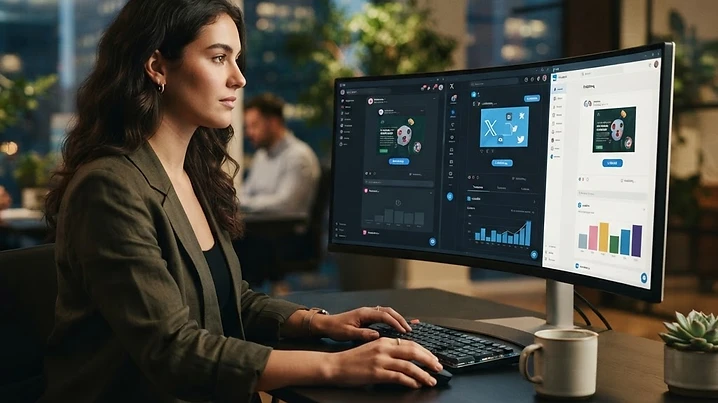
The best tool for a professional is one that acts like a word processor, not a sound editing suite. You need a system that allows you to change a single adjective in your script and have the audio adjust automatically, without you having to re-record the entire paragraph. If a tool forces you to redo an entire segment because you misspelled one word, it is not saving you time; it is just adding new steps to your day.
Look for a tool that manages the translation of text into emotion, not just into sound. You want a platform that offers a range of voices capable of professional, authoritative, or conversational tones, because your course module needs a different sound than a social media explainer. If the platform does not allow you to preview these voices against your specific script before you render, you will waste hours guessing which voice fits your brand.
Finally, the tool must handle the visual side of the equation simultaneously. The real magic happens when your text becomes both the narration and the visual layout at the same time. If you have to export audio from one place and edit video in another, you are back to the same inefficiency that stalled your progress in the first place. A professional tool unites these tasks so that your script serves as the master blueprint for the entire video.
The shift to a text-first production workflow
Transitioning to a text-first workflow means your script becomes your only source of truth. Instead of preparing for a recording session, you spend your time refining your writing, knowing that as soon as the text is perfect, the production is essentially finished. You move from the stress of performance to the precision of editing, where you control the final result by editing characters on your screen, not by modulating your vocal pitch.
When you use a platform like Fliki AI, the transformation happens instantly. You paste your text, you choose a voice that matches your intent, and the tool renders the audio. If you don't like the pacing of a specific phrase, you change the punctuation or the wording, and the tool generates a new version in seconds. This allows you to iterate on your content as often as you like, making it easy to create versions for different platforms without any additional cost or effort.
This workflow changes your relationship with your content. You stop dreading the production phase because you know it won't involve an hour of recording. You can build a routine where writing in the morning leads to a completed video by the afternoon, day after day. You are no longer limited by your physical energy or your vocal health; you are limited only by the quality of the ideas you can put onto the page.
Record nothing, produce everything
Stop wasting hours in a closet with a microphone and move your production into your browser.
- Instant narration from your existing text scripts
- Fine-tune pacing and tone without a single re-take
- Professional quality audio for every project
What you actually get, feature by feature
Instant text-to-voice conversion
Turns your written scripts into natural narration immediately to save you hours of manual effort.
Granular line-by-line editing
Allows you to regenerate only the sections you want to change without redoing the entire file.
Expansive multilingual voice library
Provides access to over eighty languages so you can reach global audiences without translation services.
Automated visual media syncing
Pairs your audio with relevant visuals so your video is ready to post without additional editing.
Professional tone selection
Enables you to match the voice personality to the specific content type, from training to explainers.
Zero-hardware production environment
Removes the need for microphones or booths, making professional video production accessible anywhere.
Your first week with a text-to-video workflow
Imagine it is next Tuesday, and instead of dreading the microphone, you spend twenty minutes turning your notes into a finished, narrated explainer. You stop trying to perfect your performance and start focusing on the quality of your ideas, because editing text is inherently more precise than trying to fix a flubbed word in a two-hour recording. By Thursday, you have shipped three videos that sat in your drafts for months. You are not exhausted by the process, and your audience is receiving consistent updates that actually sound professional.
This shift removes the emotional tax of hearing your own voice played back to you. When you move from a physical recording to a text-driven edit, you become a producer rather than a victim of your own nerves. You stop checking the gain on your microphone or trying to hide the sound of your air conditioner. You simply output the script as an audio file that sounds exactly how you need it to sound.
This is the reality for professionals who stop performing and start synthesizing. You spend your energy on the content that matters, while the tool handles the pacing and tone. By the end of the week, you will have more finished assets in your library than you managed in the previous three months combined, all without ever stepping foot in a home-made recording booth.
Answering your hesitations on price and control
You are likely worried about three things: that the voices will sound like robots, that the setup is too complex, or that the monthly cost is just another bill to track. Let us be honest about the voices first; the technology has moved past the flat, robotic monotone of ten years ago. These models now capture breathing, inflection, and cadence, making them difficult to distinguish from a human in a professional setting. You are paying for a tool that saves you the four hours it takes to record, edit, and master a single ten-minute video.
The price of a subscription is less than the cost of a basic microphone or an hour of a freelance editor's time. If you save even two hours of your own time each month, the tool has already paid for itself at your own hourly rate. If you are worried about the learning curve, remember that if you can use a word processor, you can use this platform. You are simply typing your script and selecting a voice that matches the tone of your message.
Finally, do not worry about losing your personal touch. You can still use your own voice for key introductions or personal moments while letting the AI handle the repetitive or data-heavy portions of your work. You are in control of every single syllable, and the platform serves as a production assistant that never gets tired, never makes mistakes, and never complains about the script changes you demand at midnight.

The true cost of waiting six more months
If you do not change your workflow now, you are going to lose roughly two hundred hours to manual recording frustration by the end of the year. That is a full month of working days spent fighting with microphones, re-recording lines because of background noise, and staring at software that feels like an obstacle rather than a bridge. Think about the projects you have shelved because they required audio you did not want to record; those missed opportunities are the true price of staying in your current routine.
Every day you hesitate is another day you are invisible to your audience while your competitors who have adopted these tools are shipping content twice as fast. You are essentially paying for your hesitation with your own time and growth. The professional world does not wait for you to feel comfortable behind a microphone; it moves forward based on who can deliver clear, consistent value to their audience.
You are not just losing time; you are losing the momentum that comes from consistent output. When you stop producing, your audience stops paying attention, and rebuilding that relationship is far more expensive than any monthly software subscription. Choosing to stay where you are is a decision to let your best ideas wither in a text document, forever unshared because of a simple, solvable barrier.
Making the final decision today
Deciding to use this tool is an admission that your time is worth more than the effort it takes to record your own audio. You can continue to force yourself through the ordeal of manual recording, hoping that one day you will suddenly enjoy the process, or you can accept that your talent lies in the message, not the delivery. The technology is here, the barrier is gone, and the only thing left is for you to decide that your content deserves to be heard.
This is not a permanent commitment to never record yourself again; it is a strategic choice to increase your output while reducing your stress. Once you have a professional-sounding library of content, you can evaluate your next steps from a position of success rather than a position of frustration. You are taking back control of your schedule and turning your best ideas into assets that can work for you while you focus on other tasks.
Click the link below to get started, sign up, and put one of your existing, unrecorded scripts into the platform. Once you hear your own words spoken back with professional clarity, the decision to continue will be obvious. Stop waiting for the perfect conditions to record, and start shipping the work you have already written.
What this actually looks like
Straight talk: the pros and the cons
What you get
- Eliminates the need for microphones and recording booths
- Regenerate single lines without redoing the entire project
- Library of hundreds of lifelike, human-sounding voices
- Support for over eighty languages and dialects
- Built-in visual asset library for faster production
Worth knowing
- Not intended for replacing high-end artistic voice acting
- Requires time to select the perfect voice for your tone
- Heavy reliance on internet connectivity for generation


A production studio in your browser
Focus on your message and let the platform handle the technical heavy lifting of audio and video.
- Hundreds of natural voices in 80+ languages
- Visuals and captions generated to match your narration
- Designed to let you ship content every single day
How it works, step by step
- 1
Step 1
Paste your script
Enter your prepared text directly into the editor without any special preparation.
- 2
Step 2
Select your narrator
Choose from a library of voices that match the tone of your specific content.
- 3
Step 3
Adjust the pacing
Add pauses or emphasis by simply modifying your text or punctuation marks.
- 4
Step 4
Add visual media
Pair your generated narration with relevant stock visuals or your own assets.
- 5
Step 5
Export your project
Produce your final video file, ready for immediate publishing on any platform.
Your roadmap: what the first 30 days look like
- 1
Day 1
Set up your account
Create your profile and run your first short script to hear the results.
- 2
Week 1
Clear the backlog
Convert your saved drafts into finished videos during your normal morning focus time.
- 3
Week 2
Build a library
Establish a regular publishing schedule by batch-creating your content.
- 4
Month 1
Refine your style
Find the voice and tone that fits your brand perfectly through experimentation.
- 5
Month 3
Measure the growth
Review the impact of consistent, high-quality video content on your audience reach.
Stop editing your nerves and start editing your work
You are currently standing at a choice between two futures. In one, you continue to let your best ideas sit as text because you are tired of the recording grind, eventually burning out or letting your projects fade away. In the other, you move your workflow to a platform that removes the friction, allowing you to turn your ideas into polished, narrated video in the time it takes to grab a coffee. The difference between those two futures is not talent, it is the tool you choose to work with.
Right now, take ten minutes to sign up for an account. Pick one script that has been sitting in your drafts folder—a training module, a social media post, or a quick update for your team—and run it through the generator. The moment you see and hear the result, you will realize that the barrier that held you back for months was never a lack of ability, but the wrong set of tools. You are paying for this progress with every day you wait, and that is a cost you no longer need to bear.
Everything you need to build your library of content is here, waiting for your input. You do not need a studio, you do not need expensive hardware, and you certainly do not need to subject yourself to the misery of repeated recording sessions. You need a platform that understands your time is valuable and works as hard as you do to get your message into the world. Do not let another week go by with your best work hidden in a file that no one can see. Take the step, generate the audio, and see how much faster your life becomes when the friction is stripped away.
Affiliate disclosure: the links on this page are affiliate links. If you buy through them we may earn a commission at no extra cost to you. It never changes what we recommend.