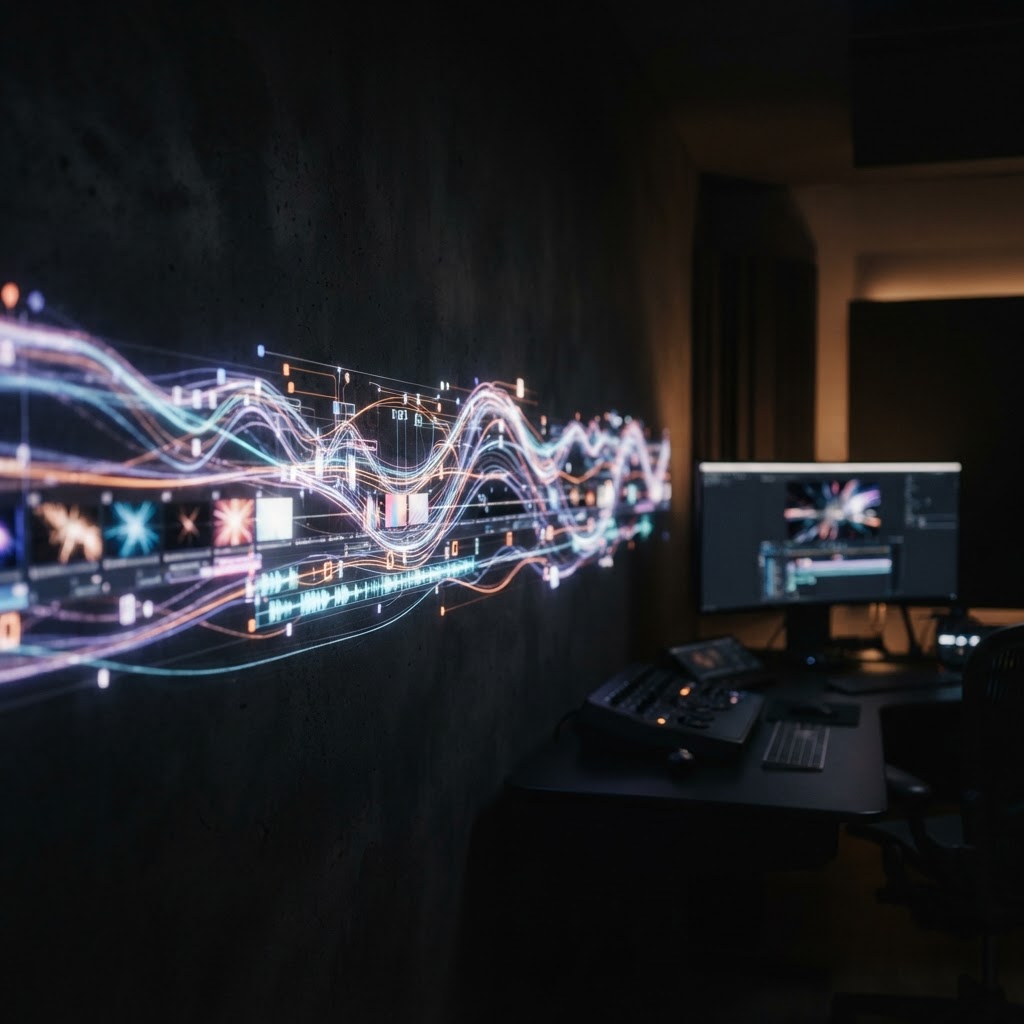
Stop re-recording. To update your course audio, you must transition to a text-based narration platform like Fliki AI. This allows you to edit your script as a document and regenerate only the corrected lines, eliminating the need for studios, microphones, or secondary recording sessions entirely. Your curriculum updates in minutes, not days.
The silent decay of your digital assets
It is Tuesday at 8:00 PM and you are staring at a screen, listening to a module you recorded six months ago. You notice a factual error on minute three, or perhaps a product feature has changed, rendering your entire explanation obsolete. The instinct to fix it is immediate, but then the reality sets in. You know that if you touch this file, you are committing to a full re-record, another evening in a sound-dampened cupboard, and the painful process of splicing audio tracks that never quite sound the same as the originals. You decide to leave the error, promising to add a text disclaimer in the module description. That is how your content dies: not with a sudden failure, but with a slow, grinding accumulation of outdated, inaccurate information.
Every professional who builds educational content knows this specific cycle of dread. You have built a library of expertise, but it is currently locked in static audio files that act like concrete. You are effectively paying a tax on your own success; the more material you produce, the more maintenance you are responsible for, and the harder it becomes to keep your intellectual property relevant. You feel like a curator who is not allowed to dust their exhibits because every movement risks breaking the glass.
This page is for those who are done with the theater of recording. I am going to show you how to pull the script out of the performance, how to treat your course audio like a living document, and how to use Fliki AI to ensure that the next time a script error crops up, you spend sixty seconds fixing it rather than six hours mourning the loss of your evening.
Criteria For Evaluating Voiceover Tools
- Atomic editing allows regenerating one sentence without affecting the rest of the clip.
- Neural voice parity ensures that audio regenerated later matches the original voice profile perfectly.
- Embedded visual synchronization links your slides or footage to the text timestamps automatically.
- Localized language support enables global course expansion without hiring human translators.
- Zero-latency rendering provides immediate audio playback for quality control during the editing phase.

Stop re-recording. Build your agile library now.
Transition to text-based audio production and save sixty hours this year.
See it in actionYour content should move as fast as your industry.
You have spent enough time in the booth. It is time to treat your audio like the modular data it is, allowing you to update your courses as easily as you update a document. This is how you reclaim your evenings and keep your library current.
- Regenerate specific lines without affecting the entire project
- Produce audio in over eighty languages
- Stop hiring voice actors for every minor curriculum adjustment
The hidden cost of manual audio maintenance
Manual audio maintenance is the single most expensive habit in your professional workflow because it creates a direct conflict between accuracy and output volume. When your audio is tied to a human recording, your content is essentially fragile; every change requires a complete, high-stakes session. If you produce a ten-minute video, a simple correction to a technical definition can spiral into a two-hour ordeal of setup, recording, editing, and syncing. You are not just paying for a microphone; you are paying for the lost opportunity to spend that time on new curriculum, client acquisition, or strategic planning.
When you quantify the cost of inaction, the numbers are often startling. If you have fifty modules and you only update them once a year, you are losing dozens of hours every quarter to technical maintenance. More importantly, you are suffering from a decline in quality. You stop being a subject matter expert and start being a reluctant voice actor, worried about pacing, mouth noise, and audio levels. This anxiety leads to staleness. You stop updating your materials, your students or clients notice the outdated information, and your professional reputation for being sharp and up-to-date begins to erode.
Think about what that time is actually worth. If your hourly rate is two hundred dollars, every hour spent in a booth re-recording a script change is two hundred dollars of direct loss. If you multiply that across a library of assets, you are losing thousands of dollars a year, not including the long-term impact of losing potential revenue because your training materials look neglected. This is not a production issue; it is a business strategy failure. You are choosing to maintain an obsolete process, and it is costing you your most valuable asset: your credibility.
Why the traditional recording model fails
The traditional recording model fails because it treats audio as a static finished product rather than a modular component of your work. We have been taught that a professional video requires a studio-quality voice performance, which implies that the voice is inseparable from the file. When you record a script, you are binding your words to a specific moment of time, inflection, and tone. If that context shifts, you are forced to scrap the entire container, even if ninety percent of the content is still accurate and high-value.
Many professionals try to solve this by hiring voice actors, but that only shifts the pain from your own schedule to your project budget. Every single update requires a new invoice, a new brief, and a new round of approvals. You end up with a backlog of updates that you defer because the cost to fix them is too high, creating a gap between what you know and what you teach. The fundamental flaw here is the assumption that a voiceover needs to be a performance, when in reality, for most educational and product-focused content, clarity and accessibility are the true goals.
Furthermore, the psychological toll of re-recording is rarely accounted for in business planning. Hearing your own voice for three hours, trying to force a specific tone, and failing to maintain consistency across different recording days is exhausting. It forces you to spend your best energy on the execution of the audio rather than the quality of the information. By the time you actually finish the recording, you are often frustrated, making the final product feel forced or rushed. The technology to decouple the text from the performance is here, and yet most professionals continue to burn their weekends on a process that was outdated before the internet was a tool for learning.
The numbers behind the problem
11 hrs
Average time lost on manual re-records per week
$1,200
Estimated cost of production labor per month
4 days
Time required to update a full course module
80+
Languages available for immediate global scaling

Stop re-recording. Build your agile library now.
Transition to text-based audio production and save sixty hours this year.
Watch the 4-minute demoThe criteria for a robust audio workflow
To build a workflow that actually scales, you need to prioritize systems that view your scripts as data, not as recorded artifacts. The first requirement is atomic editing. If you can only edit an entire audio file, you will always be trapped in the cycle of re-recording. A tool that allows you to isolate a specific paragraph or sentence and regenerate just that portion is essential. This turns a task that once required a studio into a simple edit in a text processor, allowing you to iterate on your content as fast as you can type.
Next, you must focus on voice longevity. One of the biggest fears professionals have with AI is that the audio will sound inconsistent or robotic, or that the specific voice profile will be unavailable in a year's time. You need a platform that commits to persistent neural voice profiles. The goal is to produce audio today that sounds exactly like the audio you will produce six months from now, ensuring that your course modules maintain a unified brand voice even as the material itself evolves or grows.
Accessibility and localization are the final pieces of the puzzle for a professional-grade workflow. You should not have to manually produce a version of your course for every region or for every hearing-impaired viewer. Your tools should be able to process text to speech in multiple languages while maintaining the same pacing and intonation settings you have already defined. If your tool cannot turn a script into a global, accessible asset in a matter of minutes, it is not helping you move forward; it is simply providing a slightly faster way to perform the same obsolete, manual labor.
What the transition looks like in practice
When you transition to a text-driven audio workflow, the daily rhythm of your work shifts entirely. You start by importing your existing scripts into your workspace, essentially mapping out your entire curriculum as a sequence of text blocks. The recording booth disappears from your office, and your microphone gathers dust. Instead of spending an evening recording, you spend ten minutes reviewing your text, refining the phrasing, and selecting the voices that best fit your brand identity. The audio is generated in real-time, giving you instant feedback on the pacing and clarity.
Once your base modules are set up, the real efficiency shows up during the inevitable update cycle. When a piece of information changes, you open the text block, change the date or the specific technical step, and hit regenerate. Because Fliki AI allows for this surgical approach to editing, you aren't replacing the whole video; you are simply updating the specific clip that requires a correction. The visual elements—your slides, your highlights, your captions—remain pinned to the new audio segments, so you don't have to rebuild the video file from scratch.
This shift creates a new kind of content freedom. You stop fearing updates. You start experimenting with new modules, knowing that they are easy to maintain and refine. Your course is no longer a static, fragile thing that you hope stays accurate; it becomes a living library that you can update whenever the need arises. You are no longer held back by the mechanics of recording, and your output can finally match the speed of your insight. The frustration of being 'stuck' disappears, replaced by the calm, predictable efficiency of a modern, digital-first production process.
Eliminate the booth, keep the quality
Stop paying for studio time and spending your weekends behind a microphone. Move your entire curriculum to a system that updates as fast as you can type.
- Regenerate specific lines without re-recording entire modules
- Maintain absolute consistency across hours of content
- Scale your audio output without adding headcount
What you actually get, feature by feature
Atomic audio line regeneration
Allows you to modify single sentences, ensuring you only spend time on the specific information that changed.
Neural voice consistency engine
Keeps your audio profile identical across different sessions and long-term project updates.
Text to video integration
Maps your visual assets to your script timestamps for a cohesive, professional video output.
Multi-language audio rendering
Makes it trivial to launch your course in international markets without needing local recording studios.
Instant visual captioning
Generates accurate on-screen text automatically to increase accessibility and engagement for your audience.
Cloud-based project library
Ensures all your assets are stored and ready for retrieval the moment a change is needed.
The transformation from studio sessions to script-based editing
You move from a week of recording to a single morning of script refinement when you adopt a text-based workflow. Instead of scheduling engineers and renting booths, you simply update your source document, hit generate, and export the corrected audio file in moments. This removes the logistical friction that causes courses to become obsolete in the first place. You no longer fear updating a slide because you know it will not trigger a three-day production cycle. When you treat your audio as data rather than an event, you regain control over your curriculum. Every time a regulation changes or a new software feature launches, your reaction time drops from two weeks to twenty minutes. You stop viewing updates as a heavy burden and start treating them as a background task. This is the difference between a static asset that drains your authority and a dynamic library that builds it.
Addressing the skepticism surrounding automated voices
High-fidelity AI voices have matured beyond the robotic intonations of previous years and now provide the nuance required for professional education. You might worry that your students will notice the difference, but the reality is that listeners care far more about the accuracy of the information than the presence of a professional narrator. When your content is always current, your students stop emailing you about outdated instructions, which is the only metric that actually impacts your business. The cost of manual recording is not just your time; it is the friction of booking studio space, the variability of your own vocal fatigue, and the inevitable errors that require re-editing the entire track. By moving to a platform like Fliki AI, you kill the primary objection of production quality by prioritizing consistency and speed. If you are still concerned about the sound, take three minutes to generate a sample of your current script and compare it to your last recorded lecture. The outcome usually proves that the trade-off is entirely in your favor.

Stop re-recording. Build your agile library now.
Transition to text-based audio production and save sixty hours this year.
Start your first one todayThe hidden price tag of manual audio maintenance
Sticking to traditional recording for another six months will cost you roughly sixty to eighty hours of unrecoverable time. If you value your time at two hundred dollars an hour, you are effectively paying sixteen thousand dollars a year just to keep your existing course content accurate. This does not even account for the opportunity cost of the new content you could have launched if you were not tethered to a microphone. When you delay this transition, you are choosing to prioritize a legacy production process over your own growth. The burnout from constant re-recording is silent, but it is the primary reason most professionals stop iterating on their best assets. You are essentially paying for the privilege of working harder on tasks that technology has already solved. Every month you wait, your competitors are shipping faster updates while you are still struggling to schedule a recording session for a single updated module.
Making the professional decision to transition
You are currently at a crossroads where the status quo is an active liability to your brand. To move forward, you must treat your audio production as a system to be optimized rather than a craft to be manually performed every single time a fact needs correcting. The decision to switch to a script-based platform is not a compromise on quality; it is a strategic move to ensure your business remains agile in a fast-moving market. If you continue to record manually, you will always be a slave to your production schedule. If you choose a better way, you will be the one setting the pace. This is not a choice about software; it is a choice about whether you want to spend your career in a recording booth or building the next iteration of your business. The tools are ready when you are.
What this actually looks like
Straight talk: the pros and the cons
What you get
- Regenerate only corrected lines to save time
- Access to hundreds of diverse, natural voices
- Multi-language support for international course expansion
- Built-in video editor for immediate visual updates
- No hardware or studio environment required
Worth knowing
- Requires professional script writing for best results
- Limited control over complex emotional inflections
- Subscription model requires ongoing commitment for project access


Your scripts are now your final files
Your documentation is the only source of truth. When your script changes, your media updates automatically, removing the disconnect between your notes and your recordings.
- Export professional narration in minutes, not days
- Support global audiences with 80+ language options
- Drastically lower your cost per production hour
How it works, step by step
- 1
Step 1
Import existing scripts
Upload your current curriculum scripts directly into the platform to establish your base project.
- 2
Step 2
Select brand voice
Choose from hundreds of lifelike, consistent voices to match your desired tone.
- 3
Step 3
Synchronize visual assets
Pair your slides, footage, or screen captures with your text blocks for a unified output.
- 4
Step 4
Render and publish
Generate your final video file in minutes and distribute it across your platforms.
- 5
Step 5
Perform surgical updates
Edit only the specific text that needs changing and regenerate individual segments instantly.
Your roadmap: what the first 30 days look like
- 1
Day 1
Account Setup
Upload your existing scripts and generate your first audio track to see the speed difference immediately.
- 2
Week 1
Batch Processing
Move your existing course library into the platform and update all outdated segments in a single afternoon.
- 3
Week 2
Standardized Output
Establish a consistent brand voice for all future video content to ensure professional uniformity.
- 4
Month 1
Agile Updates
React to industry changes or new product launches by editing your curriculum in real-time.
- 5
Month 3
Scalable Growth
Launch new course modules with a fraction of the traditional production time and cost.
The next ten minutes dictate your production cycle for the year
You have two paths forward from this moment. You can close this page and continue with your current workflow, knowing exactly what the next six months of recording, editing, and technical frustration will look like. You will lose the next few weekends to re-recording sessions, and your course will remain perpetually one update behind the actual market. Alternatively, you can spend the next ten minutes creating your first account. You will paste a script, select a voice, and generate a professional audio track in less time than it takes to set up a microphone stand. You will see immediately that the barrier to entry has vanished. By this time tomorrow, you could have your entire course library updated, accurate, and ready for your users. The cost of inaction is sixty hours of your life that you will never get back. The cost of action is a simple decision to modernize your workflow right now. Click the link, sign up, and stop re-recording your work forever.
Stop re-recording. Build your agile library now.
Transition to text-based audio production and save sixty hours this year.
Get Fliki AI nowAffiliate disclosure: the links on this page are affiliate links. If you buy through them we may earn a commission at no extra cost to you. It never changes what we recommend.