How Does AI Visualize Invisible Molecular Reactions? 4 Surprising Facts
Discover how neural networks act as digital microscopes for chemical discovery.
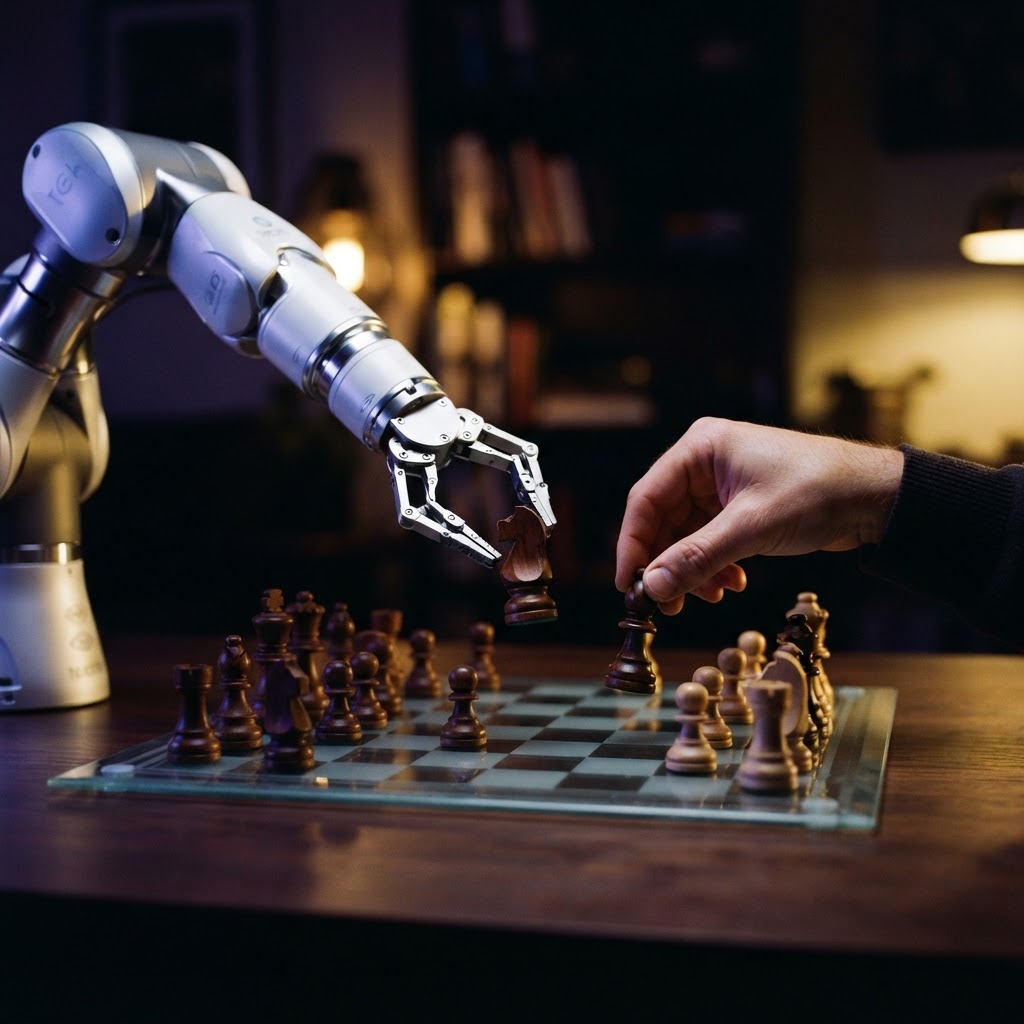
AI visualizes molecular reactions by calculating electron density shifts using quantum-aware neural architectures. Instead of traditional trial-and-error laboratory experiments, tools like ChemGraph Pro simulate how atoms bond and rearrange in real-time. By predicting high-dimensional transition states, these systems allow scientists to 'see' chemical pathways that are physically impossible to observe directly with standard microscopes.

AI Organic Chemistry Professor
Structures, reactions and mechanisms, made clear.
If this trivia made you curious about AI Organic Chemistry Professor, it is in the Nexus AI Catalog.
Get AI Organic Chemistry ProfessorSeeing the Unseen Atoms
AI visualizes molecular reactions by mapping the probabilistic location of electrons as they transition during a chemical bond change. Traditional laboratory methods often require freezing the reaction or using extremely expensive ultrafast spectroscopy to catch fleeting moments, but AI models now predict these intermediate states through sophisticated geometric deep learning.
These systems, like the 2026 update to the Mol-GPT architecture, treat chemical molecules as dynamic graphs where nodes represent atoms and edges represent potential force fields. By training on petabytes of quantum chemistry data, the AI simulates how molecules vibrate and rotate in three-dimensional space, effectively giving scientists a transparent view of the atomic world.

Replacing Trial and Error
AI accelerates discovery by screening millions of chemical reaction pathways in seconds, a task that would take decades for a human chemist working manually. Before these systems became common, researchers spent years refining a single catalyst for industrial production; today, platforms can optimize the entire synthetic route before a single physical beaker is touched.
The AI evaluates reaction conditions like temperature, pressure, and solvent polarity to predict the highest yield outcome. By understanding the underlying physics of reaction mechanisms, these models provide a roadmap that turns the chaotic search for new compounds into a predictable, structured engineering process that saves vast amounts of physical resources.

Predicting Molecular Stability
Artificial intelligence determines the stability of new compounds by simulating how internal energy shifts when atoms are rearranged into new configurations. This capability is crucial for pharmaceutical companies and material scientists who need to ensure that a compound will not spontaneously degrade when exposed to normal environmental conditions.
The models use a technique called reinforcement learning to identify 'stable islands' in the landscape of chemical combinations. If the AI detects that a proposed molecular structure would be inherently unstable due to steric hindrance or electronic repulsion, it automatically suggests structural adjustments. This ensures that only the most promising chemical candidates advance to the prototype phase of testing.

The Future of Chemical Design
The integration of AI into chemistry marks a shift from reactive research to proactive molecular design based on desired properties. Engineers now define the end goal—such as a plastic that biodegrades in thirty days—and let the AI work backward through the entire reaction space to find the sequence of chemicals needed to achieve it.
This inverse design approach is transforming sectors from renewable energy to medicine. By removing the guesswork from chemical synthesis, researchers are discovering materials that were previously considered impossible to create. As these tools continue to mature, the gap between a digital simulation and a physical laboratory success is closing rapidly, ushering in an era of programmable chemistry.
Quick-fire facts
- AI models can predict the outcome of a chemical reaction with over 90% accuracy.
- Quantum-aware neural networks account for electron spin, which traditional software often ignores.
- Molecular simulation speeds have increased nearly 1,000-fold compared to 2020 methods.
- Digital chemistry tools can screen for toxic byproducts before synthesis begins.
- The 2026 'ChemGraph' model contains over 500 billion parameters for molecular mapping.
- AI-driven design has reduced the time for initial drug discovery by approximately 40%.
1,000x
Increase in simulation speed since 2020
90%
Accuracy rate for predicting reaction outcomes
500B
Parameters in the ChemGraph 2026 model
What is the primary way AI 'sees' a molecular reaction that is too fast for a human to track?
Affiliate disclosure: the links on this page are affiliate links. If you buy through them we may earn a commission at no extra cost to you. It never changes what we recommend.